🎙️ Understanding PCOD – Episode 3
“How to Diagnose PCOD: Tests & Signs You Shouldn’t Ignore”

> Heyyy guyzzz!
Welcome back to our PCOD series — I hope you’ve been following along! By now, we’ve talked about what PCOD is and why it happens. But today’s episode is the real game changer…
Because symptoms like acne, irregular periods, or weight gain?
Bhai, woh hormonal imbalances se bhi ho sakte hain — not always PCOD!
And PCOD vs PCOS ke symptoms toh almost same-same but different hote hain, toh confusion is real.
So the big question is:
How do you actually find out if you have PCOD?
Simple answer:
👉 Get tested. Properly. Not just guesswork. Not just Google.
In this blog, we’re talking about:
✔️ The exact tests your doctor might suggest
🔍 What signs actually matter in diagnosis
📋 And how doctors confirm if it’s really PCOD (and not something else!)
And no stress — I’m not the one giving medical gyaan 😅
I asked a BAMS student to help break it down in a way that’s easy, accurate, and non-scary.
Ready to finally get clarity? Let’s gooo 👇
So my bestie has already told you PCOD kya hota hai, kyun hota hai, and you’re probably thinking – “Hmm maybe I have it too?”
But wait! Just because you’ve got 1-2 symptoms doesn’t mean it’s definitely PCOD, okay?
Let’s get real now:
Hormonal changes can happen for many reasons – stress, lifestyle, late nights, even exam season! So please don’t panic or jump to conclusions.
❗Important Truth:
Symptoms can be confusing, and PCOD vs PCOS symptoms are like twins – super similar. So how will you know what’s actually going on?
Simple → Get Proper Tests Done.
Not just “Google diagnosis” or “Yaar mujhe lagta hai PCOD hai.”
That’s why today, I’m breaking down the EXACT tests you need to confirm whether it’s PCOD or not –
(btw, I’m not the one explaining it… I brought in help from a BAMS
How is PCOD Diagnosed? (Tests & Signs You Shouldn’t Ignore)
Ever looked in the mirror and wondered why your skin is breaking out again, why your periods are always late, or why the hair on your scalp is thinning while facial hair is increasing?
You might’ve heard someone say “Shaayad PCOD hoga” – but how does one actually know? Let’s decode this together – not with fear, but with facts.
—
📌 What is PCOD?
PCOD (Polycystic Ovarian Disease) is a hormonal imbalance where your ovaries produce immature or partially mature eggs that eventually become cysts. It messes with your periods, weight, skin, mood, and fertility – and trust me, you’re not alone. It affects 1 in 5 Indian women today.
But self-diagnosing is dangerous. Only a proper medical diagnosis can confirm if you actually have PCOD or something else like PCOS, thyroid issues, or just plain old stress.
—
🚨 Common Signs and Symptoms of PCOD
Before we talk about tests, let’s see if your body has been dropping hints:
🌸 Period Problems:
Irregular or missed periods
Heavy bleeding (or too little)
Periods that come once in 2–3 months
🧠 Hormonal Imbalance Signs:
Acne (especially on jawline/chin)
Oily skin
Dark patches on neck or underarms (Acanthosis Nigricans)
💇♀️ Hair & Skin Changes:
Thinning hair or hair fall
Unwanted facial/body hair (hirsutism)
Dandruff or itchy scalp
⚖️ Weight and Mood Swings:
Sudden weight gain, especially around belly
Difficulty losing weight
Mood swings, anxiety, or fatigue
If you’re nodding your head to more than 3 of these – it’s time to see a doctor.
This is general intro we also talk about this in our previous blogs…so let’s come to the point “how you can diagnose PCOD?”
—
🧪 Tests That Diagnose PCOD
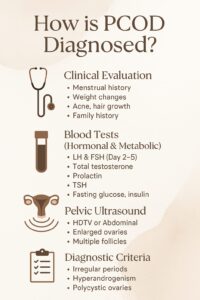
Diagnosis is usually based on 3 things: symptoms, blood tests, and ultrasound. Here’s a breakdown:
—
1. Medical History & Physical Exam
The doctor will ask about:
Your period cycle
Weight history
Family history of diabetes or PCOS
Acne/hair growth patterns
They may also check your BMI, waist-hip ratio, and signs of insulin resistance.
—
2. Blood Tests (To Check Hormone Levels)
These are usually done between day 2–5 of your period:
🩸 Hormonal Tests:
LH (Luteinizing Hormone) – usually high in PCOD
FSH (Follicle Stimulating Hormone)
Testosterone – to check for excess male hormones
Prolactin – rules out other hormone disorders
TSH – thyroid function (since thyroid issues mimic PCOD)
DHEAS – androgen levels
🧬 Insulin & Sugar Tests:
Fasting Blood Sugar (FBS)
Fasting Insulin – high insulin = insulin resistance
HOMA-IR index – a ratio used to detect insulin resistance
🩺 Lipid Profile:
To check for high cholesterol or triglycerides (common in PCOD)
—
3. Pelvic Ultrasound (Transvaginal or Abdominal)
This is done to check your ovaries.
✅ In PCOD, ovaries may appear:
Enlarged
With 10 or more small cysts (often called a “string of pearls”)
But here’s the thing: not all PCOD patients show cysts. So diagnosis isn’t based on ultrasound alone.
—
🔍 How is PCOD Officially Diagnosed?
Doctors use the Rotterdam Criteria, which says you need 2 out of 3 of the following:
1. Irregular or absent periods
2. Excess male hormones (seen through symptoms like acne/hair or blood reports)
3. Cysts in ovaries (via ultrasound)
If you meet 2 of these, it’s likely PCOD.
—
❤️ Humanizing the Diagnosis – It’s Not Your Fault
Let’s be real – the word “cyst” can sound scary. And being told you have a “hormonal issue” can feel like something’s wrong with you.
But PCOD doesn’t mean you’re broken. It just means your body needs a bit of extra love and balance – through food, movement, sleep, and maybe some medicine.
—
💡 Pro Tip: Don’t Google Panic
Many girls Google symptoms and assume the worst. But remember:
PCOD doesn’t look the same for everyone
A proper diagnosis requires a combination of tests
Early diagnosis = better management
If you’re experiencing the signs, book a gynaecologist appointment. Trust me, it’s way better than overthinking for months.
How is PCOD diagnosed
PCOD tests and signs
PCOD symptoms in females
Blood tests for PCOD
PCOD diagnosis process
Hormonal imbalance test
Pelvic ultrasound PCOD
Hope in this blog all this question are answered and now you all know the answers to your questions 💗
—
🧘♀️ Coming Soon on the Blog:
PCOD vs PCOS: What’s the real difference?
Natural ways to manage PCOD at home
PCOD Diet Plan for Indian Women
Weight Gain & PCOD: Can they go together?
—
💌 Final Thoughts – You’re Not Alone
If you’re dealing with weird skin changes, missed periods, or mood swings that feel out of control – know that many of us have been there. PCOD is not the end of your health story. It’s just a chapter. And with the right care, you can absolutely thrive.
—
Got questions or want me to cover your story on the blog? Drop them in the comments or email me at urveshpatilwork@gmail.com
Let’s break the stigma and support each other 💖
Sooo yayy that’s it for this blog hope this is much informative and you get clearance on what to do if you have symptoms guyz pls follow us and told your story we are waiting for it …..!
Sign-in off
Your pcod warrior’s
(Umahh 💋💋💋… lot’s of love)